What is a REST API? The key to flexible system integration
By teamnext Editorial Team
A definition is a good starting point. It helps to begin with the second part of the term.
API stands for application programming interface. In practical terms, it is an interface that allows other programs to connect to a software system. Data is exchanged at source code level.
REST stands for representational state transfer. The exact meaning is explained further below. For now, the key point is this: a REST API serves as an interface between distributed systems.
Digital Asset Management, or DAM, is the discipline of managing digital media such as photos and videos. This article also addresses the role a REST API can play when integrating DAM systems.
What is a REST API used for?
REST APIs use the HTTP protocol. They are used for web services that require automated information exchange between networked applications.
Examples:
-
An online service such as an ecommerce shop can be connected via a REST API to a company’s PIM system or ERP system.
-
A SharePoint instance can be integrated to enable remote work on specific files.
The systems involved can be built differently and can use their own data formats and data structures. The role of a REST API is to provide a standardized way of communication between these systems.
6 principles of a REST API
The REST standard is based on six principles. They go back to Roy Fielding, who described them comprehensively in 2000. An API that implements all mandatory principles is considered RESTful. Principle 6, code on demand, is optional.
1. Client server architecture
The separation of client and server supports a clear division of responsibilities. In practice, a user interface requests services that a server provides, for example a database server. This makes scaling easier because both components can evolve independently.
2. Statelessness
Client requests must contain all information the server needs to process them. The server must not store client state. This improves scalability because incoming requests can be distributed across different machines.
3. Cacheability
Frequently requested server responses should be cacheable so the server is not overloaded unnecessarily. Cache rules must define how long cached data remains valid. This prevents clients from receiving outdated information.
4. Uniform interface
Client server interaction follows uniform standards. These are based on four conditions.
-
Addressability of resources: A server resource can contain many types of data, but it must be uniquely addressable via a URL.
-
Representations for modifying resources: Clients interact with resources using representation formats such as JSON or XML. These formats contain the information required to update or delete a resource.
-
Self descriptive messages: Messages must contain the information required for interpretation by a client or server.
-
HATEOAS, Hypermedia as the Engine of Application State: Clients can navigate through application resources dynamically using links embedded in server responses.
5. Layered system
Requests must be able to pass through independent network layers such as proxy servers or load balancers. Client and server code should not need to change. These intermediate layers can improve performance and security significantly.
6. Code on demand, optional
The server may transfer code to the client for local execution when needed.
What REST means
This brings meaning to the term representational state transfer. It describes the transition from the current state of an application to the next state. This state transition happens through the transfer of representation data. Access to that data is performed via standardized HTTP methods, also referred to as HTTP verbs.
The 5 most important HTTP methods
-
GET: Requests a resource from the server. The server state is not changed. GET is the most used HTTP method because it is also required to load web pages.
-
POST: Creates a new resource under the specified target. The response typically returns the link to the new resource. POST is used for form submissions or file uploads.
-
PUT: Creates a resource. If the resource already exists, it is updated. PUT is relevant when content must be updated.
-
DELETE: Deletes a resource.
-
HEAD: Requests metadata for a resource.
Functional sketch of a REST API
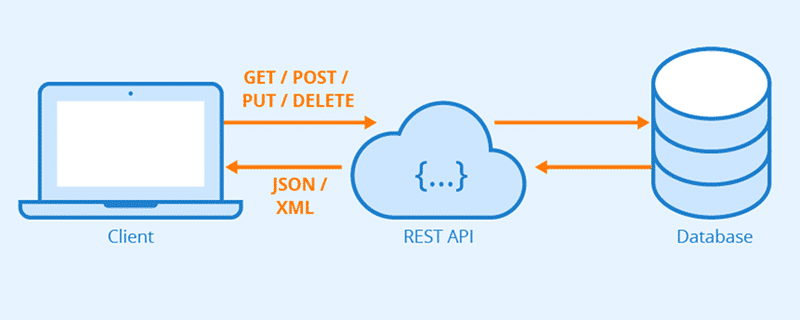
Practical example: Accessing a DAM system via a REST API
Digital Asset Management platforms enable companies to store, organize, and distribute digital content such as images, videos, or documents efficiently. If these resources need to be integrated into other applications, a REST API can be useful.
Scenario: Retrieving and embedding an image in a website
Assumptions:
-
An image should be embedded in a website from a DAM platform.
-
The DAM platform provides a REST API to access existing resources.
The integration can be described in four steps.
Step 1: Identify the resource
The resource is addressed via a URL, for example:
https://mediahub.ai/api/File/Original/19b6da72-c3b5-40a1-ba63-c7d24a678721/REST-API.jpg
Step 2: Apply an HTTP method
To retrieve the resource, a GET request is sent to that URL. Such requests can be executed using different tools and environments:
-
cURL
-
Postman
-
Shells such as PowerShell
-
Web browsers
-
Programming languages
Step 3: Process the response
After processing the request, the DAM platform returns an HTTP response. A representation format such as JSON or XML provides the requested image as a link or as a direct data stream.
Step 4: Display the image in the website
After receiving the response, the link or data stream can be used to display the image on the website.
Benefits of a REST API in a DAM context
-
Flexibility: Developers can use DAM content in many ways and integrate it into different applications.
-
Scalability: REST APIs are stateless, which makes them suitable for scalable architectures.
-
Simple integration: REST is based on HTTP and can be used with standard web development tools and languages.
-
Independence: REST APIs are platform and language agnostic, which supports broad compatibility.
Conclusion
A REST API is a powerful and flexible interface for networked applications. It is commonly used to connect software systems over the internet. Standardized HTTP methods help keep communication clear and efficient.
In a DAM context, REST APIs enable the integration of digital content into many applications and services. This allows end users to access an organization’s media library directly from their preferred working environment. It accelerates workflows and supports collaborative work.