Power of image recognition: The 10 most important use cases
By teamnext Editorial Team
Image recognition is a capability that computers increasingly master through artificial intelligence. Whether faces, objects, or symbols. Whenever visual information needs to be captured and interpreted, machine based image recognition is used.
Common examples include Google image search, smartphone unlocking via Face ID, photo management, plant identification apps, and functions related to autonomous driving.
Before assessing the current state, a short historical perspective is useful. Today’s performance builds on early forms of character and pattern recognition.
The pioneers of image recognition
The value of machine based character and pattern recognition was identified early. In the 1910s, two machines were developed:
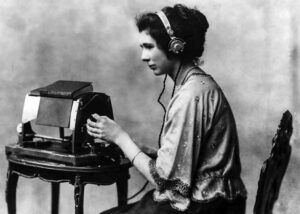
• the Optophone, which converted printed letters into sound
• Hyman Eli Goldberg’s Controller, which read printed text and translated it into telegraph code
Mary Jameson, blind from birth, using an Optophone, photo from 1918
In 1931, Emanuel Goldberg presented a machine in Dresden that used light measurement and pattern recognition to search for metadata on microfilm reels. In 1949, early experiments around barcode technology followed, including work by Bernard Silver and Norman Joseph Woodland. In the 1970s, optical character recognition, OCR, advanced significantly, with major contributions associated with Ray Kurzweil. Letters and numbers could be recognized reliably even across varying fonts.
Pattern matching as a core principle
Early systems focused on characters and simple patterns. Even OCR is not image recognition in the narrower sense. The underlying logic is related:
• scans are segmented, typically one segment per character
• pixel patterns are matched against known templates
• a character value is assigned when similarity is high
A digital photo is also a set of pixels. The challenge becomes far more complex because real world objects, contexts, and variations are much more diverse than a limited alphabet.
Key examples in facial recognition
Facial recognition is a common field of application. It is not only about detecting faces but often about extracting biometric features. Similarities can support re identification and, in certain contexts, identification.
1. Facial recognition for authentication
Typical applications include:
• unlocking computers and smartphones, for example Face ID or Windows Hello
• access to buildings such as hotels and offices
• passing airport checkpoints such as boarding gates
• payments, for example Smile to Pay by Alipay
• pilots in retail and public transport by payment providers and technology partners
• use as part of two factor authentication
Identical twins remain a known edge case. The practical impact is limited because the situation is rare.
2. Facial recognition in professional image management
In 2008, Google introduced face recognition in Picasa. Picasa was the predecessor of Google Photos. After processing a large photo library, searching for specific people became possible and creating albums, collages, or videos became faster.
Facial recognition is also used in Digital Asset Management. The main benefit is faster retrieval of images and more efficient workflows.
• Digital Asset Management, DAM, is the professional management of images and other media files.
3. Facial recognition in reverse search
Reverse image search is established through Google, Bing, and similar services. Face search goes further:
• upload a frontal portrait
• receive other images of the same person if they have been indexed
Services such as PimEyes index publicly available images and enable face search. This can be powerful for investigative purposes and risky in terms of misuse, for example stalking.
4. Facial recognition in law enforcement
Law enforcement agencies use facial recognition to identify suspects in photos and videos. This can speed up investigations. At the same time, the same capability can be used for illegitimate surveillance, which drives ongoing debate.
5. Facial recognition in social media and public spaces
Facebook started automatic photo tagging in 2010 and discontinued the feature globally in 2021.
In the European Union, the use of facial recognition in public spaces is heavily constrained. The EU AI Act provides broad prohibitions for real time remote biometric identification in public spaces, with narrowly defined exceptions.
Notable examples in object recognition
Faces are objects in technical terms. The separation between facial recognition and object recognition is used here for clarity.
6. Object recognition in autonomous driving systems
Object detection is essential for autonomous driving. Key requirements include:
• lane detection
• interpretation of traffic lights and road signs
• detection of nearby objects
• fast positioning and motion prediction
This belongs to computer vision. Processing must happen within very short time windows. Beyond cameras, radar, lidar, and ultrasonic sensors are often used.
Cockpit of a Tesla Model S P100D
Waymo One is a real world example. Waymo describes the service as a fully autonomous ride hailing operation available in markets including Phoenix and San Francisco.

7. Object recognition in reverse search
Photo based search is widely used. Google Lens is a prominent example. These systems improve continuously through machine learning.
For specialized domains, dedicated apps can be more reliable, for example:
• Flora Incognita
• PlantNet
• PictureThis
Product search by photo also relies on object recognition after specific training.
8. Object recognition in image management and stock photography
Automatic tagging has replaced manual input in many workflows. For common subject matter, recognition works well in practice, for example:
• chair
• power drill
• bicycle
Stock photography has used automated tagging for years.
Technical challenges include:
• identifying brand, model, or type often requires dedicated training
• biological species are difficult because differences can be subtle
• strong visual similarities can confuse systems, a well known example is Karen Zack’s chihuahua or muffin collage
Deep Learning can also detect stylistic features. More difficult is reliably extracting message, concept, and higher level meaning.
9. Object recognition in medicine
In medicine, object recognition supports diagnostic workflows, for example by analyzing:
• X ray images
• CT scans
Systems can flag subtle anomalies and compare findings against large reference datasets. Approaches for early cancer detection are especially relevant and are being tested clinically.
10. Image recognition in checkout free retail
Example Amazon Go
Amazon Go stores are often cited as an advanced example of computer vision in physical retail. The goal is shopping without a traditional checkout.
Typical flow:
• smartphone check in before entering the store
• items are taken from shelves and displays
• customers leave without a visible checkout process
Smartphone check in before entering an Amazon Go store.
The system combines sensor technology and computer vision to associate items and actions with a customer session. The exact technical setup is not fully disclosed publicly.

Additional application areas
Further common areas include:
• quality inspection in manufacturing, for example parts and sensitive food items
• insurance, for example automated assessment of damage photos
• military applications, for example autonomous drones and robotics